Basic vs Premium A+ Content: Is Premium Worth It?

Oct 16, 2026 · 9 min read
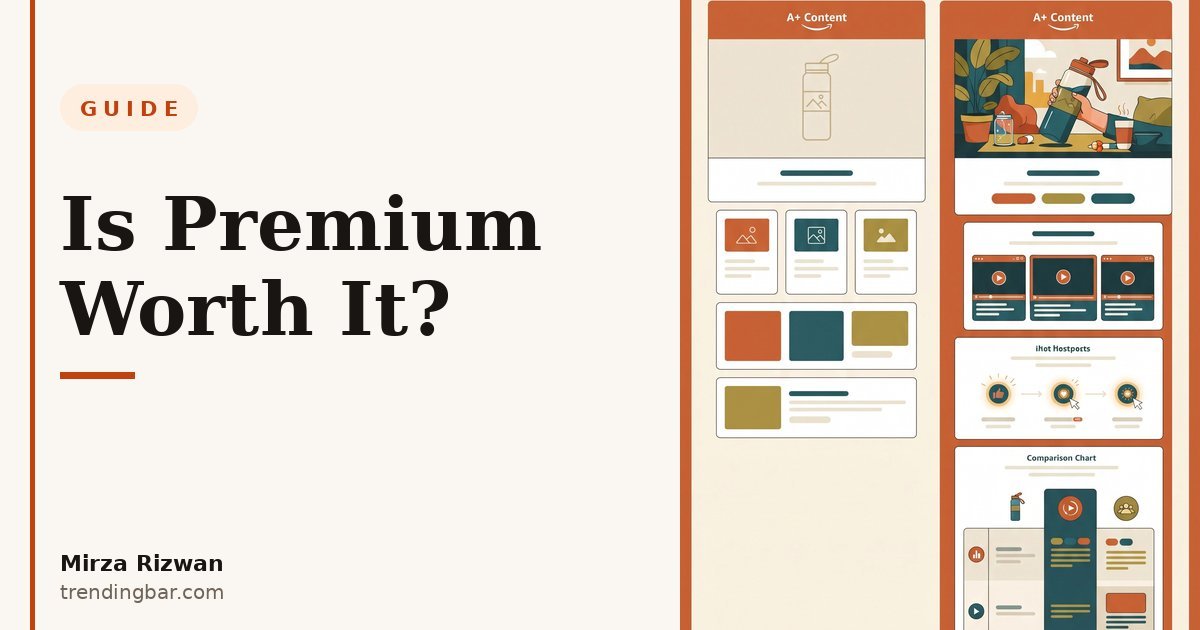
Every few months a seller asks me the same question: "Should I pay for Premium A+?" And every time, my answer disappoints them a little. Because the real answer isn't a yes or no. It's: it depends on what your listing is actually trying to say.
I've built A+ pages in both tiers for eight years now. Basic done well beats Premium done sloppily. That's not a hot take, it's just what happens when the tier becomes the goal instead of the shopper. Here's the honest breakdown.
What Basic A+ actually is
Basic A+ is the free visual layer that sits where your plain product description used to be. You get up to five modules from a library of fourteen, images up to 970 x 300 pixels, plus the modules that matter most: image panels with text, and the comparison chart.
That comparison chart is the workhorse. It's shoppable, it answers "why this one and not the cheaper one next to it," and it does the closing argument your bullet points can't make visually. In my experience, a listing with a good Basic A+ and a smart comparison chart is already ahead of most of its category.
Amazon's own numbers back the floor: Basic A+ can increase sales by up to 8%, per Amazon's own published data. Note the phrasing. "Up to." That number assumes your A+ actually supports the sale: good images, clear copy, one coherent story. Slap five modules of pretty filler under your bullets and you'll get a fraction of it. The tier doesn't convert. The content does.
What Premium A+ actually adds
Premium isn't "Basic with more stuff thrown in." It's a different canvas: up to seven modules from nineteen, images up to 1,464 x 600 pixels, video modules, interactive hotspots, clickable image and video carousels, Q&A modules, and shoppable content that Basic can't touch.
The modules I'd actually care about as a designer: the full-page hero (no text crowding the image, finally), interactive hotspots that let a shopper tap a feature and learn what it is, and the video module that puts a product demo right in the description area where the undecided buyers live.
And yes, Amazon publishes a bigger number for it: well-implemented Premium A+ can increase sales by up to 20%, again per Amazon's internal data. Same caveat, louder this time: "well-implemented" is doing a lot of heavy lifting in that sentence.
That is Amazon's pitch, but real brands back it up too. Garden of Life's brand manager Day Tomko put it this way on Amazon's own A+ page: "A+ Content has helped us build our brand story while helping consumers discover products in our catalog... and ultimately drive sales." I like that quote because it names the two things A+ is actually for: brand story and product discovery, not keyword gaming.
Basic vs Premium, side by side
Here's the practical comparison, stripped of the sales pitch:
| Feature | Basic A+ | Premium A+ |
|---|---|---|
| Cost | Free | Free (eligibility gated) |
| Modules per page | Up to 5 of 14 | Up to 7 of 19 |
| Image size | Up to 970 x 300 px | Up to 1,464 x 600 px |
| Video | No | Yes, multiple modules |
| Interactive hotspots | No | Yes |
| Clickable carousels | No | Yes |
| Q&A module | No | Yes |
| Comparison chart | Yes (standard) | Yes (enhanced) |
| Brand Story | Separate format, both tiers | Required for Premium eligibility |
Notice the last row. Premium isn't just a toggle. I'll explain that next, because this is where most sellers get surprised.
The eligibility catch nobody tells you about
You can't just decide to use Premium A+. Amazon gates it, and the gate is stricter than most sellers expect: a Professional selling account, Amazon Brand Registry, a published Brand Story on every brand-owned listing, and five approved A+ Content project submissions in the trailing twelve months.
There's a terminology trap in that last one. As a 2026 analysis on PPC Land points out, Amazon counts submitted layouts, not individual design blocks: one full A+ page with five design blocks logs as one submission. Sellers have reported sitting on multiple approved pages for a single product and still not qualifying. If you're a new brand, plan for this. Premium is a reward for brands that already publish a lot of A+, not a starting point.
My read: that gate exists to keep Premium from becoming a landfill of half-finished fancy pages. Honestly? Fair enough.
So is Premium actually worth it?
Here's my real opinion, and I know some agencies won't like it: for most listings, no. Not yet.
Premium pays off when your product needs explaining. Complex features a photo can't show. A price tag that makes shoppers hesitate. A category where every competitor has the same specs and you win on trust. Electronics, high-ticket kitchen gear, technical skincare, anything with a mechanism inside. If your listing's job is "show the buyer what this does and why it costs more," Premium's hotspots and video are real tools.
But if you sell a straightforward product (a set of mixing bowls, a phone stand, a basic yoga mat), Premium won't save you. Your buyers don't need an interactive hotspot to understand a bowl. They need to see it's sturdy, see it in a kitchen, and see why yours isn't the $14 alternative. Basic does all of that. The extra modules would just be more space to fill with more filler.
And here's the uncomfortable bit: most Premium A+ I audit is Basic content wearing a fancier outfit. Same five modules, same shallow copy, same stock-looking lifestyle shots, just with a video module stuck on top. That page doesn't earn the 20%. It earns a shrug. Before you chase the tier, ask yourself whether your Basic A+ is genuinely excellent. If it isn't, fix that first. It's free, and the jump from "no A+" to "good Basic" is the biggest conversion jump on the whole ladder.
A wrinkle most sellers miss: A+ is a conversion tool, not an SEO tool
One more thing to factor into the decision. Practitioner testing has consistently shown that A+ body text doesn't move A9 keyword rankings. Discoverability comes from titles, bullets, and backend terms. A+ earns its keep by converting the traffic that arrives.
Related: Amazon has been phasing out the seller-written alt-text field in A+ modules since 2025 (fully removed in Europe by 2026), and an Amazon AI now generates the image descriptions (reported by PPC Land; Amazon has published nothing about it). The practical takeaway for design: you no longer control the metadata, so you control how unambiguous the image itself is. One short benefit overlay on a clear scene reads correctly to the vision model, the shopper, and Google at the same time.
What does that mean for the Basic vs Premium question? It means the tier choice is purely about persuasion surface, not search visibility. Pick the tier that lets you make the clearest case to a human.
My decision checklist, as a designer
When a seller asks me which tier to build for, I run through this list. Steal it:
- Is your product hard to understand in photos alone? If yes, lean Premium: video and hotspots earn their keep.
- Are you priced above the category median? Premium trust signals (bigger imagery, Q&A modules) help justify the gap.
- Is your Basic A+ already excellent? If not, stop. Build excellent Basic first. Five great modules beat seven mediocre ones.
- Do you meet the eligibility gate? Brand Story on every listing plus five approved submissions in twelve months. If that's six months of work away, invest in Basic now and graduate later.
- Do you have real video? Premium without video is like buying a bigger screen to watch the same blurry footage. If your demo video is a slideshow with music, stay Basic until you have something worth playing.
I've seen listings do very well on Basic alone: the comparison chart, a strong hero panel, one clear lifestyle scene. And I've seen Premium pages with video that genuinely moved the needle on expensive, complicated products. The pattern is always the same: the tier serves the story, never the other way around.
Don't buy a bigger canvas until you know what you'd paint on it. Basic done well beats Premium done sloppily, every time.
Want a deeper tour of what each module actually does? I've written a full breakdown of the A+ modules and when to use each one, or see how to choose an A+ designer if you plan to hire this out, and a guide to the Amazon A+ Content service hub covering the whole format. And if your A+ exists but the needle isn't moving, the problem usually isn't the copy. Worth a read before you spend a rupee on an upgrade.
FAQs
Is A+ Content free?
Yes. Amazon's FAQ confirms A+ Content is free for sellers who meet the eligibility requirements: Brand Registry enrollment and a Professional selling plan. The cost is in the design work: good A+ takes real designer hours, and Premium takes more because the modules are bigger and richer.
Can I have Basic A+ on some products and Premium on others?
Yes, eligibility is at the account level, not per-ASIN. Once you qualify for Premium, you can use Premium layouts on some listings and Basic on others. Plenty of brands do exactly this: Premium for the hero products, Basic for the long tail.
Does Premium A+ rank better on Amazon than Basic?
There's no evidence either tier is indexed differently by A9. Practitioner testing shows A+ body text doesn't move keyword rankings in either tier. The ranking benefit of A+ is indirect: better-converting pages earn more sales, and sales feed Amazon's product graph. Premium's job is persuasion, not SEO.
If you're deciding where to put your design budget, I'd argue the question is bigger than tiers: is your whole listing (images, A+, copy) — telling one coherent story? If you want an honest outside read, I (Mirza Rizwan) build A+ content and listing images at trendingbar.com, and my free audit will tell you exactly where your current page is leaking sales, Basic or Premium.