Folding Carton vs Rigid Box: How to Choose the Right One

Oct 22, 2026 · 10 min read
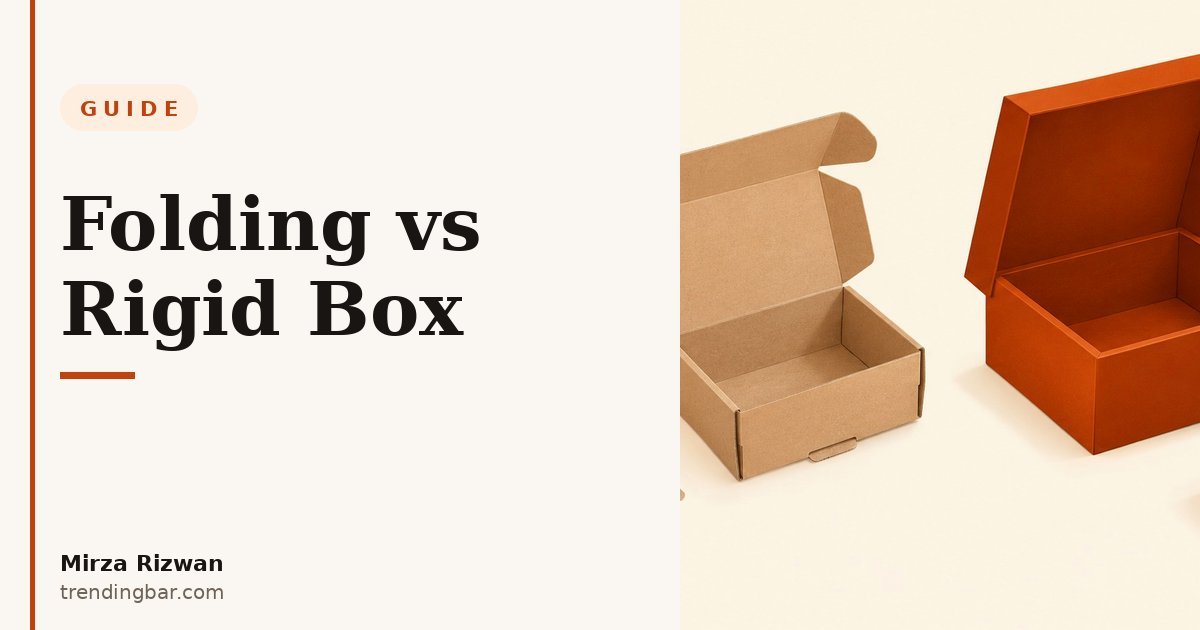
I have this conversation about once a month. A founder sends me a packaging brief and says, "I want it to feel premium." And what they mean is: a rigid box. Somewhere along the way, the internet decided that a thick, heavy box equals a good brand.
It doesn't. A rigid box on a $25 product isn't premium. It's a margin eating your profit, shipping air across the ocean, and charging your customer extra for the privilege. I've watched sellers pick rigid for the wrong reasons, and I've watched a well-designed folding carton outsell them.
So let's settle this properly. Folding carton vs rigid box, no fluff, from someone who designs both.
What a folding carton actually is
A folding carton is the box you know from cereal, cosmetics and most retail shelves. One piece of printed paperboard, cut and creased, shipped to the packer flat, folded into shape when the product goes in. That's the whole trick: it travels as a flat sheet and becomes a box at the last moment.
The flat layout is called the dieline, and getting it right is where most folding carton projects succeed or fail. If you’re planning a packaging project from scratch, my packaging design service page walks through how I take a product from brief to print-ready dieline. Paperboard comes in different thicknesses and coatings, and the choice there affects everything from print quality to how the box survives shipping. I've built dozens of these. The format is boring in the best possible way: cheap to make, easy to store, familiar to every packer on the planet.
What a rigid box actually is
A rigid box is built like a book cover. Thick chipboard wrapped in printed paper, glued at the corners, and it cannot fold flat. Ever. That's the source of both its luxury feel and its logistical pain.
What you get: structure that holds its shape, a satisfying lid or magnetic closure, weight in the hand that reads as quality. What you pay for: a much higher unit cost, freight on empty air (because it ships assembled), and minimums that are usually higher than folding cartons. It also needs hand assembly or semi-automatic packing in most cases, which slows down fulfillment. This is the box for perfume, premium electronics, high-end skincare, corporate gifting. It earns its keep when the product's price justifies the ceremony.
The cost gap nobody puts in the quote
Here's the part most packaging articles skip, probably because it doesn't sound exciting. A rigid box always costs more per unit. Not a little more. A lot more. Multiple times more, typically, once you count the box itself, the freight on assembled boxes, and the slower packing.
Folding cartons are the opposite. They ship flat, so a thousand of them take up barely any space. They run on standard carton equipment, which means more printers can quote them, which means you can actually negotiate. And my guide to real price ranges for packaging design covers what the design work itself should cost, so you can budget the whole thing instead of guessing.
One more cost that hides: storage. A pallet holds thousands of flat folding cartons. The same pallet holds a fraction of that in rigid boxes, because they're mostly air. If your warehouse charges by the pallet or the cubic meter, rigid costs you money every single day it sits there. Nobody tells you that in the sample box.
Side by side: folding carton vs rigid box
Here it is in one glance:
| Folding carton | Rigid box | |
|---|---|---|
| Structure | Single sheet of paperboard, folds into shape | Chipboard wrapped in printed paper, permanently assembled |
| Unit cost | Low, the cheapest retail box format | High, several times a folding carton typically |
| Ships flat | Yes, tiny freight footprint | No, ships assembled, which means freight on empty air |
| Unboxing feel | Familiar, functional; premium possible with finishes | Ceremonial: weight, lid and structure read as luxury |
| Protection | Moderate, needs inner protection for fragile items | Strong, the structure protects on its own |
| Print finishes | Foil, embossing, spot UV, soft-touch: the full range | Same finishes, plus edge gilding and magnetic closures |
| Best for | Most consumer products, retail shelves, DTC under ~$60 | Luxury, gifting, heavy or fragile products, $60+ price tags |
When a folding carton is the right call
Be honest with yourself and check how many of these fit:
- Your product sells under about $60. Below that line, the box should be invisible infrastructure, not a second purchase decision.
- It lives on a retail shelf. Folding cartons hang, stack and face forward better than almost anything, and they print beautifully.
- You ship thousands of units. The flat-ship math compounds fast. At volume, the savings aren't a rounding error, they're a margin strategy.
- Your design changes. Seasonal editions, new variants, label tweaks. Reprinting a folding carton is fast and affordable. Rebuilding a rigid box program is a project.
- Weight matters for freight. If you're selling on Amazon, every gram and every centimeter of the outbound box affects your fees and your shipping bill. Light, flat cartons win this quietly.
And one thing people get wrong: a folding carton can absolutely look premium. Foil stamping, embossing, soft-touch laminate, textured stocks. A finished folding carton can sit next to a rigid box on a shelf and hold its own. The box format doesn't cap your brand. Cheap design caps your brand.
When a rigid box is worth the money
Now the other side. A rigid box earns its price when:
- The unboxing is the marketing. Dotcom Distribution's packaging research found that 40% of online shoppers have shared a photo or video of a product on social media, and consumers are 1.5 times more likely to share gift-like boxes than plain brown ones (Dotcom Distribution Packaging Report 2015). If your buyers unbox on camera, the box is a media asset.
- Your price tag is $60 or more. Above that line, customers expect the packaging to match the price. A $90 serum in a thin carton feels wrong. The box has to earn the trust the price asks for.
- It's a gift. Nobody wraps a gift in something that looks like a shipping container. Rigid boxes with magnetic lids and ribbon pulls are the default for a reason.
- The product is heavy or fragile. Chipboard structure protects better than paperboard. For glass bottles, dense electronics or anything that can't take a corner hit, rigid is functional, not decorative.
- You need the premium packaging stats on your side. The same Dotcom Distribution research found 52% of online consumers are likely to buy again from a retailer that delivered premium packaging (Dotcom Distribution eCommerce Packaging Survey). When retention is the game, the box is a lever.
As Maria Haggerty, CEO of Dotcom Distribution, put it: "Boring brown boxes represent lost opportunity." I agree with her, with one amendment. So does a rigid box that bankrupted the product inside it.
The Amazon angle nobody puts in the quote
If you sell on Amazon, this decision isn't just about branding. It's math.
FBA charges you on the size and weight tier of what you send in. A rigid box is heavier and bulkier than a folding carton for the same product, which means it can push you into a higher fee tier before you've sold a single unit. Multiply that across thousands of units and the box choice quietly becomes one of your biggest cost drivers. Seller-fulfilled shipping works the same way: dimensional weight pricing punishes air.
There's also the listing side. Unboxing content drives social proof. 36% of consumers have watched an unboxing video, and 55% of that group bought a product as a result (Dotcom Distribution Packaging Report 2015). If your category rewards unboxing (beauty, tech, gifting), a rigid box pays you back in content your buyers create for free. If your category doesn't, you're paying luxury freight for a box nobody films.
So the Amazon rule of thumb: folding carton by default, rigid only when your price point and your category's unboxing culture justify the fee drag.
The mistake I see most
Founders choose the box for the brand they wish they had, not the brand they have. A $29 gadget in a rigid box doesn't look premium. It looks confused, and the customer can feel the $8 box inside the $29 price. It's the packaging version of the premium-look trap: finishes and formats that don't match the product's price create suspicion, not desire.
The opposite mistake exists too, rarer but real: a $150 product in a flimsy carton that collapses when you pick it up. That's not minimalism. That's a refund waiting to happen.
My rule is simple. The box should be worth about what the price implies. Match the format to the price tag, then spend your design budget making that format the best version of itself. A brilliant folding carton beats a mediocre rigid box every single time. And if you're unsure whether your current packaging is pulling its weight, I wrote a guide to the signs your packaging needs a redesign that's worth ten minutes of your time.
My 5-minute decision checklist
Answer these five and you'll have your answer:
- What's the retail price? Under $60: folding carton. Over $60: rigid is on the table.
- Will anyone film the unboxing? Yes and your category shares: rigid. No: folding.
- How heavy is the product? Dense, fragile or glass: rigid's structure earns it. Light and durable: folding.
- What's the shipping math? FBA or international DTC: folding carton's weight and flat freight usually win.
- Can the unit cost carry it? If a rigid box eats more than ~15% of your product cost, it's not packaging, it's a hobby.
Three or more answers pointing at folding? Stop debating and design a great folding carton. Three or more pointing at rigid? Get quotes and run the freight math before you fall in love with a sample.
I'm Mirza Rizwan, I design packaging and Amazon creative at trendingbar.com. If you want a designer's read on your specific product, I offer a free packaging audit: I'll tell you which format fits, where your current box is leaking money, and what I'd change first, within 48 hours.