Nobody Reads Your Packaging. That's Why Design Matters More.

Oct 5, 2026 · 9 min read
A few years back, a client sent me 400 words for the back panel of a kitchen gadget box. He'd written the whole Amazon bullet list into it. I read the draft, called him, and said I was going to delete almost all of it. He went quiet on the phone.
"But that's the information," he said.
"Who's going to read 400 words on a box?" I asked.
"Nobody," he admitted.
"Exactly," I said.
We shipped the box with about 40 words, one hero claim, and icons. He sold through his first production run in six weeks. I won't pretend I can prove the box did it. But I'll tell you he reordered the same design without changing a single word. I've designed retail boxes across five product categories over eight years, and I have yet to meet a package that sold more because it had more words on it.
Why care about something nobody reads?
Because "reading" was never the point. Packaging isn't a document, it's a signal. And signals get judged in seconds, not sentences. Shoppers don't evaluate your copy. They evaluate what your box feels like it's saying before a single word registers.
The numbers back this up, and I say that as someone who distrusts most packaging statistics floating around marketing blogs. A Dotcom Distribution survey found that 52% of online shoppers are likely to make a repeat purchase from a retailer that delivers premium packaging, and nearly 4 in 10 would share a photo of the delivery on social media if the box was unique or gift-like. MeadWestvaco's "Packaging Matters" study found 37% of consumers had tried a product simply because the packaging caught their eye, and 57% said packaging influences them more when they're shopping in-store.
Those aren't reading statistics. Nobody is out here speed-reading cartons. They're judging statistics. Paul Rand, the man who designed the IBM and UPS logos, put it better than I ever could: "Design is the silent ambassador of your brand." Silent. He didn't say design is your brand's spokesperson. It's the ambassador that says everything without opening its mouth.
What shoppers actually notice in 3 seconds
Three things survive the scan: your wordmark, one hero claim, and whether the box looks expensive. Everything else is garnish. When I start a packaging project, the first thing I map is what the shopper's eye hits in order, because that order is the entire design:
- The wordmark, readable at arm's length. If it needs squinting, it doesn't exist.
- One number or claim they could repeat to a friend. "Reads in half a second." "Blocks RFID." One. Not three.
- A price signal. Finish, weight, structure. The box itself saying "I'm not cheap" before any copy tries to.
- The compliance block. Age grades, choking-hazard marks, symbols. Nobody reads these either, but retailers and Amazon demand them, so they get engineered in quietly.
- Everything else is negotiable. Yes, including your brand story paragraph. Especially that.
Here's where I disagree with most branding advice: your box doesn't need to tell your story. Nobody is buying a box to be told a story. Your box needs to make one promise loud enough to carry across a shelf, and then get out of the way. I've seen the same habit wreck Amazon listings too. In my audit of 50 Amazon listing images, 76% failed on basic checks, and the recurring failure was sellers writing for readers while shoppers scan. Packaging is the same disease, just printed on cardboard.
The thermometer box: my loudest lesson
I made the spec the brand. When Boxiki Kitchen brought me their instant-read meat thermometer, the box had to say "precision instrument" before it was even opened, because the product's whole reason to exist is precision. So I designed a 195 x 83 x 25 mm folding carton around one idea: the numbers lead.
The "Instant 0.5 Second" badge became the loudest element on the front panel after the wordmark. That single spec is the one thing a buyer is actually shopping for in this category, so it got the biggest real estate. The accuracy claim, plus or minus 0.9 degrees Fahrenheit, became the second icon, paired with a target glyph so precision reads as a feature instead of a footnote. The 180-degree auto-rotating display got its own callout. The back panel got a spec block sized for the Amazon detail page, because on Amazon your box art doubles as listing imagery whether you planned it or not.
I learned this the hard way, by the way. An early version of this design gave every feature equal weight, equal icon size, equal dignity. It looked thorough and professional. It also blurred into mush at three feet. The moment I picked a winner and made everything else subordinate, the box started to read. Hierarchy is a favor you do the shopper. Most designers won't do it because picking one thing feels like betraying the other four. Do it anyway.
The puzzle box that sold itself at the store
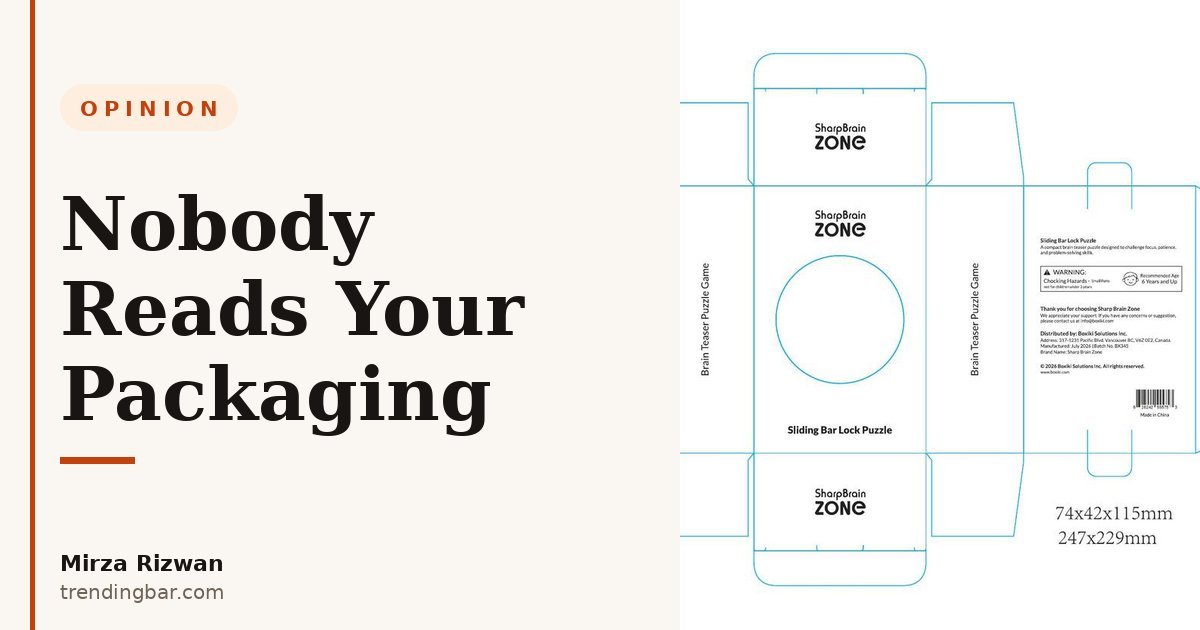
SharpBrain ZONE came to me with a mechanical sliding-bar lock puzzle and an unusual brief: make the packaging as considered as the product inside. So I stopped thinking about the box as a wrapper and started thinking about it as a feature.
The result was a die-cut carry box with the handle built into the top of the carton. A kid can grab it. A retailer can hang it. The interior was tuned to 74 x 42 x 115 mm, fitted to the puzzle's exact shape, so there's no rattle and no wasted material. The back panel carries the brand's focus-and-learning story, and the age-grade block, choking-hazard warning, and 6+ recommendation were engineered to clear Amazon compliance on the first pass.
Notice what's missing from that list: foil stamping, embossing, "premium" finishes. The box doesn't whisper luxury. It works. And that's my second piece of heresy for this post: packaging doesn't need to look premium to sell. It needs to be considered. A handle a child can grip sells more puzzles than a gold logo ever will, because it answers the question the parent is silently asking: "will my kid actually carry this around and use it?" Design that answers a real question beats design that just looks expensive. Every time.
What I'd cut from your packaging tonight
If you want a rule of thumb: cut everything that can't be read from arm's length in three seconds. The back panel is not a website. Nobody is scrolling it. Here's how I think about the usual suspects:
| What's usually on the box | What survives the scan | Verdict |
|---|---|---|
| 8 to 12 feature bullets | One hero claim | Cut 11 of them |
| Brand story paragraph | The wordmark | Move it to your website |
| "Premium quality" claims | Finish, weight, structure | Show it, don't say it |
| Full instruction text | Nothing | QR code, inside the box |
| Compliance marks | Retail buyers notice them | Keep, but engineer them small |
The pattern is simple. Words get cut. Signals stay. Your finishes, your dieline, your one hero number, these do the selling. The rest is either moved inside the box (instructions, story, the QR code that actually gets scanned after purchase) or deleted with no mourning. It's the same one-claim discipline I used in the Boxiki Kitchen loaf pan listing teardown: pick the single thing the buyer is shopping for and make it unavoidable. I go deeper on the visual-hierarchy mechanics in my 2026 guide to Amazon listing images, and the same principles apply on cardboard.
This is the core of my work at trendingbar.com's packaging design practice: boxes engineered for the three-second scan, not for the reader who doesn't exist. I also design the full system around it, from dielines to Amazon-ready back panels, because a package that can't survive retail, Amazon, and the compliance desk isn't a design, it's a sketch.
Frequently asked questions
Does packaging design really affect sales?
Yes, and the data is unusually consistent. Dotcom Distribution found 52% of online shoppers are likely to repurchase from retailers that ship in premium packaging, and MeadWestvaco found 37% of consumers tried a product simply because the packaging caught their eye. Packaging doesn't sell through copy. It sells through the instant judgment a shopper makes about quality, price, and trust.
How much text should go on packaging?
As little as you can get away with. My rule: one hero claim, the wordmark, and whatever compliance requires. Back panels work best as a scannable spec block with icons, sized so each element reads at arm's length. If you can't read it in three seconds from two feet away, it's decoration, not communication.
Can one design work for both Amazon and retail?
Mostly yes, but the structure has to flex. Amazon products often ship in polybags or plain cartons, so the printed box becomes unboxing theater and listing imagery. Retail needs shelf behavior: hangability, a visible handle, a price signal that carries from six feet. I design one artwork system with shared brand assets, then adapt the dieline and hierarchy for each channel instead of designing twice.
Selling a product whose box has to do the talking? I offer a free packaging audit where I'll review your current box and tell you the three things I'd cut and the one claim I'd make louder, within 48 hours. You can also see the range of my packaging design services and past packaging work before you decide.